A voxel universe shaped by its creators. We’re building toward a future where anyone can make their own world—with tools, code, or the help of AI agents.
WORLDNEXUS / A SHARED FOUNDATION. MANY POSSIBLE WORLDS.
One foundation. Your world’s identity.Original concept illustration · not gameplay footage
NUKIAL IS BUILDING WORLDNEXUSVoxel sandbox / Creator platform visionEarly-stage · Built with intention
Published projects
Products you can use today.
Alongside WorldNexus development, explore our released work: an Android puzzle game and a Unity developer tool, each with a public store listing.
Android game · On Google Play
SYNCHRO – Slide Puzzle
A sliding puzzle game where one swipe moves two blocks at once. Plan both routes, use obstacles and special tiles, and guide the pair to their goals. Supports offline play, undo, hints and English/Vietnamese.
A save/load toolkit for Unity projects, covering settings and player data. The package provides JSON and binary formats, Dictionary support, AES encryption, backups and data validation, with demo scenes to help developers integrate it.
Product descriptions follow their official store listings, checked on 15 October 2026. Open the store pages for current availability, compatibility and release details. WorldNexus remains in development.
01 / The vision
More than a world. A way to make worlds.
Creating a custom world often means stitching together an engine, authoring tools, and content pipelines. WorldNexus starts with a voxel sandbox and aims to bring that foundation together—so creators can shape the landscape, the systems, and the experience.
A survival frontier. A fantasy civilization. A world no one has imagined yet. The rules should be yours.
◇
A shared foundation
Reusable mechanics, world identity, and content contracts.
⊞
Distinct worlds
Each WorldPack owns its theme, content, and gameplay rules.
↗
A creator ecosystem
A planned path from authoring tools to code and AI assistance.
02 / Creation, your way
Different starting points. The same possibility.
Our goal is to make world creation approachable without putting a ceiling on what experienced developers can build. These are the creation paths we’re working toward.
[ 01 ]
Shape it with tools.
Use the WorldForge authoring direction to assemble content, define environments, and package a world’s identity. A visual path for creators who want to focus on the experience.
Authoring foundation in development[ 02 ]
Extend it with code.
Build deeper systems through WorldSDK extension contracts. The long-term goal is a documented public SDK and API ecosystem for packs, mods, and creator integrations.
Public SDK & APIs planned[ 03 ]
Imagine it with AI.
Work toward an idea with agents that plan, draft assets and content, assemble a WorldPack, and use test feedback to refine it. Inspect the output and decide what becomes part of your world.
AI-assisted creation planned
03 / Planned agent workflows
From an idea to a world you can inspect.
Our vision is a connected creator workflow: AI agents help carry an idea through planning, authoring, assembly, and testing, with fewer manual handoffs between tools. You review the content, see what failed, and choose what to refine or keep.
[ 01 / PLAN ]
Give the idea a shape.
Describe the setting, how players live in it, and the experience you want. A planning agent would turn that brief into a world outline, content needs, dependencies, and achievable creation steps.
[ 02 / CREATE ]
Make the building blocks.
With art and authoring tools, agents could help draft textures, material concepts, voxel models, and item and recipe definitions. Each output stays available to inspect, edit, or replace before it enters your pack.
[ 03 / ASSEMBLE ]
Bring the world together.
Planned assistance could compose terrain, biomes, settlements, dungeons, and portal layouts between dimensions. WorldForge would be the content authoring path for assembling these pieces into a coherent WorldPack.
[ 04 / EXTEND ]
Define how life works.
Future agents could draft crafting and economy systems, abilities and progression, creatures, NPCs, quests, and spawn rules. A code authoring agent could propose extension code against WorldSDK contracts and planned public APIs, with each world's themes and resources owned by its WorldPack.
[ 05 / CHECK ]
Let tests guide the next draft.
A QA agent would invoke validation tools to check content identities, dependencies, and resource references, then run builds and automated regression tests. Where applicable, save/load and server authority checks would help expose problems before a world is activated.
[ 06 / REFINE ]
Review, revise, and package.
Agents would report failures and propose revisions, then repeat the relevant checks. You keep final control over assets, content, and code, and approve an inspectable WorldPack for packaging and use.
Creator agents build the world.
WorldForge and planned WorldSDK/public API interfaces would connect agents to authoring and QA tools. Creators would review assets, NPC roles, quests, and rules before approving a WorldPack. Development automation and test artifacts exist today; the integrated creator agent workflow is planned.
NPC agents live inside it.
Our agent vision also extends into play. In-game NPCs are designed as agents whose real-time conversations and decision intents are generated by AI language models (LLMs), guided by their role, goals, and the surrounding world. This runtime direction is planned alongside the creator workflow.
Worlds with characters that can respond.
The design gives NPC agents context from nearby players and world events, so they can decide how to respond and what to say in the moment. Imagine a merchant discussing available wares, a villager reacting to a changing situation, or a quest giver adapting a conversation to the player's circumstances. These are intended use cases for the experience we're building toward.
AI intent. World-approved action.
An LLM would generate dialogue and propose decision intent; the authoritative server would validate and execute gameplay actions through approved world rules and contracts. Each WorldPack would define the character's role and available actions, while WorldCore stays independent of any AI provider. The aim is responsive characters within a coherent, shared world.
04 / The WorldPack philosophy
Same engine. Different laws of nature.
A world should carry its own meaning. Magic belongs to a fantasy pack. A survival loop belongs to its gameplay pack. The shared foundation stays reusable.
FOUNDATION
WorldCore
Generic mechanics and stable contracts that worlds can share.
IDENTITY
WorldPack
Themed rules, resources, content, and explicit dependencies.
EXPERIENCE
Your world
A distinct setting built on content that is validated before activation.
The AI vision follows the same boundaries: human-reviewed content before activation, and NPC agent actions validated against the active world's rules during play.
05 / Possible worlds
One idea can open an entirely new world.
Survival and Isekai are the current gameplay pack directions. These illustrations show the broader creative possibility; they are concepts, not a catalog of released worlds.
The wild frontier
Gather, craft, build, and adapt. A survival world where the landscape sets the challenge.
Illustrative survival concept
Beyond the portal
Magic, settlements, and adventure. The Isekai direction gives its fantasy rules a home.
Illustrative fantasy concept
A new frontier
Imagine remote colonies, unfamiliar resources, and systems designed for life beyond Earth.
Illustrative sci-fi concept · Future possibility
06 / Inside the build
The work behind the possibility.
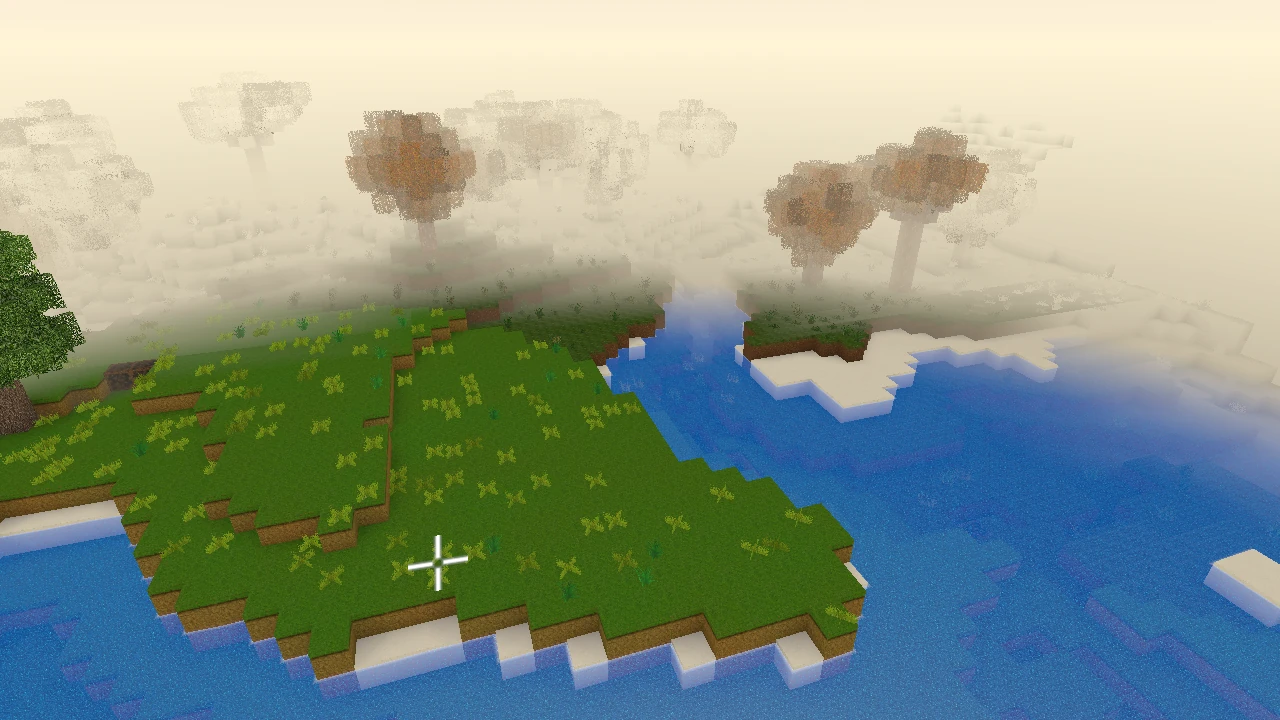
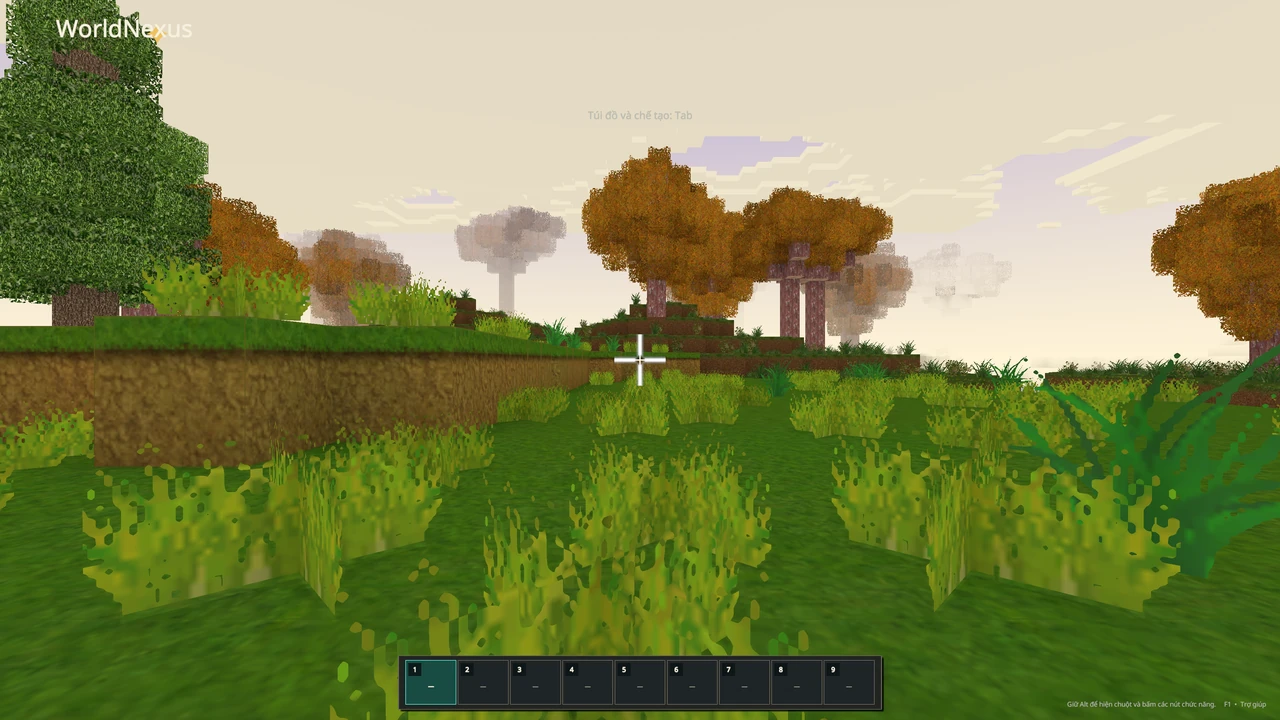
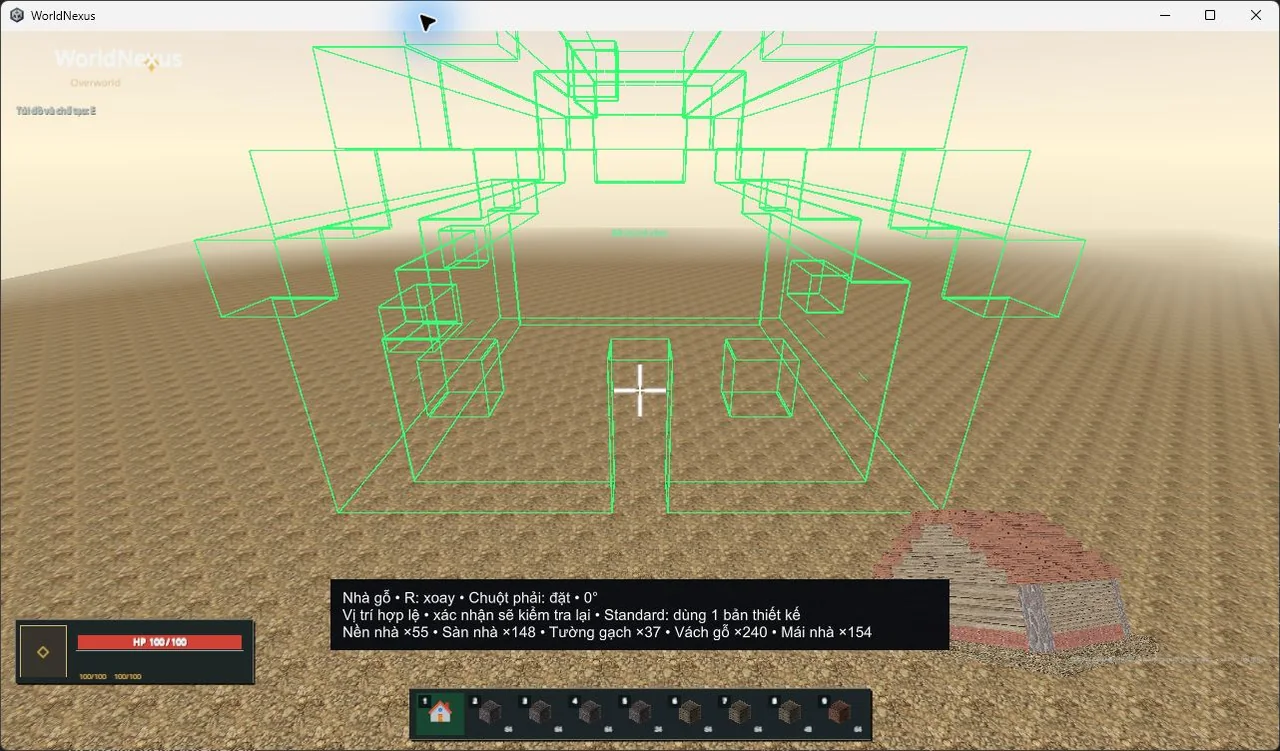
In-game screenshots from WorldNexus development builds. These are work in progress, not final art or a public release. Open any image to inspect the full capture.
Survival landscape
Development capture ↗
A view across voxel hills and water in a Survival development world. Terrain and visuals are still in progress.
Exploring the grasslands
Development capture ↗
A first-person view of a Survival development world, with grassy terrain, trees and the player hotbar.
House placement preview
Development capture ↗
A house placement preview in a staged development scene, with the building interface visible.
07 / Built from the foundation up
Creative freedom needs solid ground.
WorldNexus is in active development with Unity and C#. The architecture separates reusable mechanics from themed content, with authoring and extension contracts as part of the foundation.
WorldCore
Generic mechanics, stable identity, and content contracts shared across worlds.
WorldForge
The authoring, validation, and content-packaging direction.
WorldSDK
Extension contracts in the codebase; a publicly available developer ecosystem is a future goal.
WorldPack
Survival and Isekai gameplay directions, with Standard and Creative modes independent of a pack’s theme.
Play architecture
An offline development path and dedicated server authority architecture. Multiplayer release readiness remains a separate development milestone.
Development research
Build. Observe. Refine.
A persistent world needs repeatable checks as well as creative ideas. These selected development results help us examine world variety, continuity and gameplay behavior.
Habitats across seeds
Development habitat tests sampled ten named biomes across two seeds: Bamboo Grove, Desert, Forest, Grassland, Savannah, Shrubland, Snow, Swamp, Taiga and Tundra. These are bounded test sites, rather than ten fully released biomes.
Continuity for creatures
Automated tests cover creature persistence, native agent pose restoration and selected combat interactions. The purpose is to check that creatures retain the expected state and behavior across supported scenarios; this does not establish LLM-driven intelligence.
World replay and lighting
Selected saved-world replay and lighting scenarios have passed development checks. Broader testing continues to examine how a world returns after loading and how visual conditions behave.
Diagnosing reliability
Development diagnostics investigate intermittent allocator file-commit failures. This remains an open investigation, with reproducible evidence guiding the next checks.
These results describe selected development scenarios, not release readiness. Public creator tools and LLM-driven NPC dialogue and decisions remain planned work.
Authoring explorations
Try the shape of an idea.
Explore three interactive interface studies for skill creation. These standalone browser prototypes investigate visual organization and editing interactions; they do not execute WorldNexus gameplay.
◎
UI DESIGN PROTOTYPE
Magic circle topology
Explore a circular arrangement for connecting skill ideas and inspecting their relationships.
A detailed snapshot of verified development work and remaining acceptance gates. WorldNexus is still in development; individual passing scenarios do not mean the game is ready to release.
Verified in development
Build, select and export
Basic house rotation and placement have been confirmed. The developer/Creative design tool now supports 3D drag selection, adding and removing volumes, undo/redo, and export without changing the source world. Physical usability and an actual export/import workflow passed on 14 October.
Partial · P5 / T25
From designs to biomes
Tree, house and road samples have passed export/import and native preview checks. Controlled Windows runs also verified rendered placements and restoration after a fresh process. Broader world generation acceptance, generation cost and secondary-dimension parity remain open; these samples are not automatically enabled as production content.
Verified scenarios · broader gates open
Depth, sky layers and portals
Survival and Isekai development scenarios cover bedrock at Y = −1024, sky layers at Y = 2048–4096, portal travel into a separate dimension, and save/reload. Portal interaction uses right-click or walking through. Long-session streaming, performance and broader physical playtests still need acceptance.
Open · T24
Sky-island streaming
Stuttering still reproduces when travelling through the sky dimension. The 15 October Editor diagnostic measured outbound sky frame intervals at p95 175.2 ms and p99 205.6 ms, with a 1,406 ms return-path outlier. These are instrumented diagnostic results, not a release benchmark or proof of an optimization gain.
Reopened · T28-W2
Dedicated-server world parity
Dimension routing, authority and headless scenarios have test evidence. A subsequent audit reopened the production network milestone: the secondary server still needs shared native terrain and payload contracts before its world can be considered equivalent. Multiplayer release readiness is not yet established.
Implemented · physical checks remain
Interface, audio and reliability
Responsive panels, launch-menu Escape handling and audio edge cases have passed scoped automated checks. Listening and balancing, additional screen sizes and real-input checks remain. Intermittent save-file publication and shutdown investigations also remain open; passing focused tests does not close those reliability gates.
Next: review the shared native terrain/payload implementation plan, then verify secondary-server parity and generation performance. Continue the outstanding Survival, input, audio and save/restart checks. Public creator tools, public SDK/API access and integrated AI agents remain future work.
Status basis: the project delivery checklist, verification records and current roadmap, reviewed on 15 October 2026. Results are limited to the scenarios described above; there is no announced public release date.
Under the hood · 15 October 2026
Libraries, APIs and adapters.
An implementation map based on the current source and delivery evidence. Expand a module for its concrete contracts, responsibilities and remaining gates. API names below refer to internal C# contracts, not a published web API or public SDK.
Core types separate content handles, entity identity, player identity and operation streams. Save/network boundaries must preserve stable identity and the frozen content mapping, never a vendor-local array index.
Evidence and remaining acceptance
Implemented types; broader identity admission remains gated. T10 / L02 / L07 and ADR-0021/23 retain their own acceptance scope.
Declarations resolve references before registry freeze. MappingHash and ContentHash distinguish identity mapping from content definitions. Active packs expose resolved capabilities; thematic resources belong to their pack.
Evidence and remaining acceptance
Registry and active-pack contracts are present. T25 remains PARTIAL for external-pack lifetime, broader configuration and end-to-end content acceptance.
Gameplay actions enter through commands and owning stores. Inventory exchange, item drops and equipment are represented separately from UI; revisions and authority checks constrain mutations.
Evidence and remaining acceptance
Offline move/split/merge and selected save/restart scenarios have evidence. T11 still needs the full physical-input, rejection and multiplayer-transfer matrix.
Formula graphs compile against declared content and generic resource operations. Authority validates and executes actions. The compiler must not hard-code mana, qi or a concrete WorldPack namespace.
Evidence and remaining acceptance
Compiler/authority source and generic-cost UI integration exist. T22 is PARTIAL: the full draft → compile → equip → cast → restart and interaction matrix is still open.
IVoxelBackend exposes readiness, reads, commit, capture and verified apply. Optional contracts add prepared mutations and batched restore. Preparation validates without publishing; rollback restores before-images until completion. Loading missing targets is a separate phase.
Evidence and remaining acceptance
15 October server-backend regression: 39/39 PASS for the tested transaction/dimension scope. This repairs atomicity, but does not prove native terrain or payload parity.
Persistence encodes identity-aware generations and dimension state, with validation and staged restoration around publication. Selected house, terrain and authored-design cold-process restores have evidence.
Evidence and remaining acceptance
Reliability remains open: intermittent allocator file publication, broader crash/quit behavior and the crop/farming base-write transaction gap are not closed by focused restore passes. T24 / T27.
Core owns session preflight, coordinated offline lifecycle, dimension contexts and replication scope. Transport adapters connect these contracts to multiplayer; gameplay does not directly call FishNet.
Evidence and remaining acceptance
Offline handoff and scoped routing tests exist. T28-W2 is reopened/PARTIAL; dedicated secondary-world parity, fresh multi-client/restart and long-session gates remain separate.
The adapter binds generic voxel contracts to VP4 terrain, content, snapshots and design capture. Native appearance includes more than a block handle: tint, rotation, microvoxel data and properties matter for restoration.
Evidence and remaining acceptance
15 October audit found the secondary-server payload rejected by the native decoder. Terrain/payload parity is still open. An inactive native-context probe was rejected; near-height calls are not proven safe for parallel use. No vendor-source workaround.
Adapter classes carry inventory, voxel, dimension, ability and other scoped messages through FishNet. Wire codecs and server routes enforce the relevant authority and identity contracts.
Evidence and remaining acceptance
Selected dedicated weapon paths, dimension routing and headless checks have evidence. Transport checks do not establish full world parity or co-op readiness; L07–L09 remain deferred delivery obligations.
Core authoring types define design documents and codecs; Forge provides Editor authoring/validation. The in-game developer/Creative workflow adds 3D volume selection, mask editing and export for import into development assets.
Evidence and remaining acceptance
M4 physical selection and actual export/import passed on 14 October. P2 capture performance remains PARTIAL for cold/outlier budgets; P5 biome use is not fully accepted. These are not publicly released creator tools.
Generation provenance records the source context needed to reproduce a world. The authored-design planner/catalog connects imported designs to placement, while the VP4 adapter projects them into native chunks.
Evidence and remaining acceptance
Tree/house/road rendered placement and cold restore have bounded evidence. P5/T25 remains PARTIAL for secondary-dimension parity, generation budgets and broader player acceptance. Sky-streaming lag is still reproduced.
Presenters and UI project gameplay state; composition roots connect content, authority, adapters and lifecycle. Menu, inventory, HUD and audio are application-facing components, not new authority owners.
Evidence and remaining acceptance
12 October scoped UI suite: 395/395 PASS; the associated PlayMode set recorded 26 PASS and 1 skipped. Full screen/input/accessibility and listening/balancing acceptance are still open. T03–T09 / T26.
WorldSDK / public APIs — planned
The repository currently contains four owned packages: Core, Forge, VoxelPlay4 integration and FishNet integration. WorldSDK describes the future public contract, samples and integration-guidance surface; it is not a separately shipped SDK package here. No public API endpoint or stable external compatibility promise is announced by this update.
Evidence labels describe specific historical runs, not a newly executed full-suite result. Architecture proposals, source presence and passing scoped tests are different levels of progress. This public view summarizes the owning checklist, evidence and roadmap without changing their acceptance status.
08 / Where we’re going
A big vision. A deliberate path.
We’re building the playable foundation first, then growing the tools around it. Public creator access, agent-assisted authoring, real-time NPC dialogue and decisions, and a broader API ecosystem are ambitions ahead of us.
Now / In development
The playable foundation
Voxel sandbox and shared world architecture
Survival and Isekai gameplay directions
Building, content, save/load, and offline experience
Authoring and extension contracts
Next / Planned
More complete worlds
Deepen gameplay and validate the player experience
Advance co-op and dedicated server readiness
Refine world authoring and content workflows
Prepare clearer creator-facing documentation
Long term / Vision
Creation for everyone
A public SDK and API ecosystem
Agents for assets, world assembly, and system authoring
Test-guided iteration and human-approved WorldPacks
NPC agents with LLM dialogue and context-based decisions
An ecosystem of independent creators
This is our direction, not a release schedule. WorldNexus is not publicly launched; public SDK/API access, integrated AI-assisted creation, and LLM-driven NPC dialogue and decisions remain future features.
Build the possibility with us
Let’s talk about what’s next.
Nukial is an independent, founder-led project. We’re interested in conversations with startup programs, potential collaborators, and people who care about the future of world creation.
This website uses localStorage to remember your language preference. It offers no accounts, forms or uploads. Email links open your mail app; messages are handled by the email providers involved.
Cloudflare delivers and protects this website and may process network requests and technical metrics, including website analytics. Read more in the resources below.
This is an informational website about a product in development. Product directions, previews and interface prototypes may change. The website is not a game release and does not imply affiliation with technology providers or approval by a startup program.
Images and previews are shared for information; their display does not grant a redistribution license. For questions about the project or website, contact the founder.